The Saffron Dawn
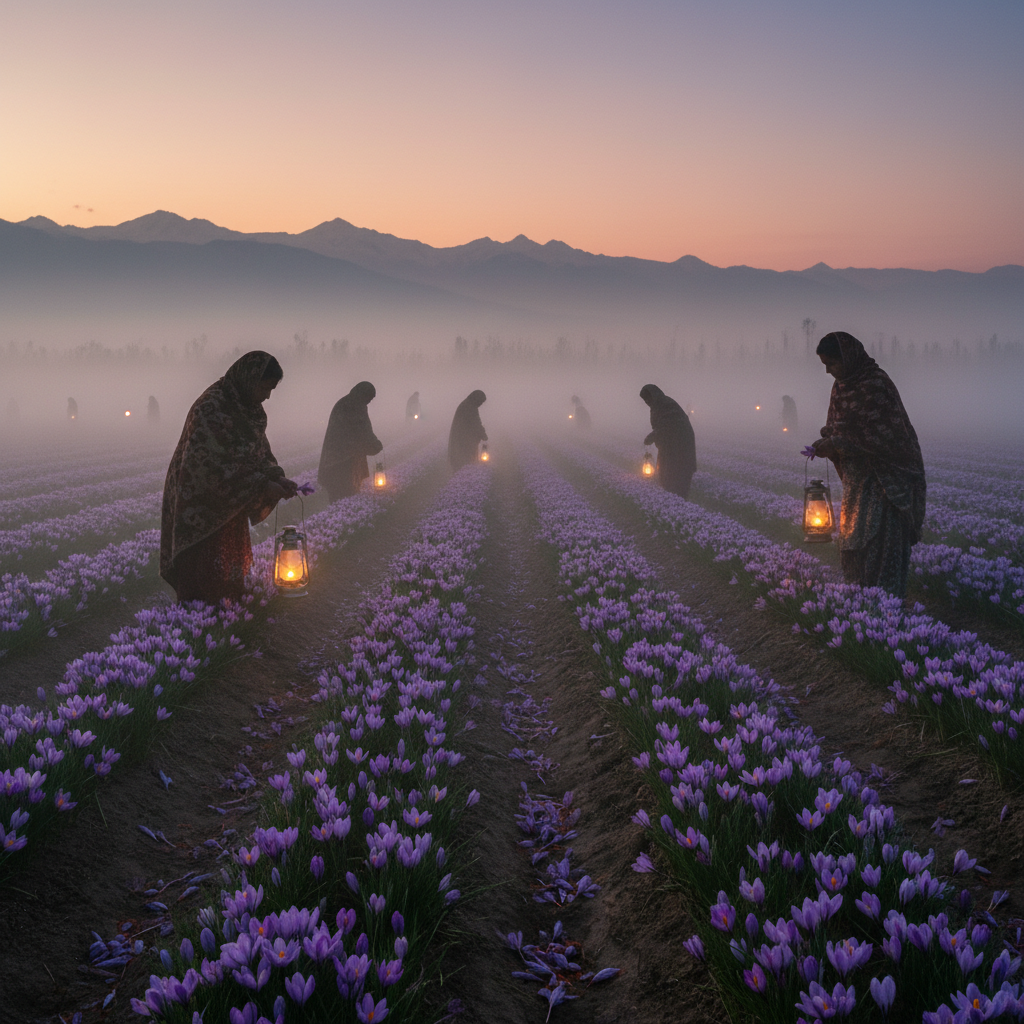
One of the great saffron tales — a pre-dawn walk through the Pampore crocus fields, where Kashmiri Mongra saffron is hand-picked at first light. A Param Kesar® harvest story.
The First Light The cold arrives before the light. It’s a damp, searching chill that seeps into your bones, the kind that belongs only to the pre-dawn hours of the Kashmiri autumn. In the darkness, the world is reduced to whispers and the soft shuffle of feet on a dirt path. We are in Pampore, a town cupped in the vast palm of the Kashmir Valley, and the air itself feels electric with anticipation. This is the heart of saffron country, and for a few fleeting weeks in October and November, this land awakens for a ritual as old as the mountains that surround it. I follow the silhouette of Ghulam, a farmer whose hands are a roadmap of seasons past, his face etched with the quiet dignity of a life lived in concert with the soil. A small lantern swings from his hand, casting a warm, dancing glow that does little to pierce the immense dark. "It is time," he says, his voice a low rumble, the words condensing into a small cloud before his face. "The flower does not wait." He is right. The saffron crocus, Crocus sativus , is a notoriously impatient beauty. It blooms and wilts in a single day, offering its treasure only to those who rise to meet it in this liminal space between night and morning. An Ocean of Amethyst As the first hint of grey bleeds along the eastern horizon, the world reveals itself. And it is breathtaking. Field after field unfolds, not in the familiar green of agriculture, but in a soft, hazy carpet of violet. It’s an impossible color, a sea of amethyst flowers unfurling in the low light. The air, thin and crisp, carries their scent—a delicate, honeyed fragrance that is more memory than perfume. This is the bloom, the moment the entire year has been building towards. Women, draped in woolen phirans and shawls against the cold, move through the rows with a practiced, almost balletic grace. They bend low, their fingers—nimble from a lifetime of this work—plucking the delicate blossoms and placing them into wicker baskets called krinjols . It is a selective, gentle harvest. Each flower is chosen, not stripped. I watch a grandmother teach her granddaughter, her weathered hand guiding the girl’s small fingers. "Only the new ones," she murmurs, her voice carrying on the still air. "The ones that opened for you this morning." It’s a dance of generations, a transference of knowledge that happens not in classrooms, but here, in the cold earth, under a sky slowly turning to soft rose and gold. There is no machinery that can do this. The soul of the saffron is in the touch of the hand that plucks it, that knows the precise moment a flower is ready to give up its gift. The Crimson Separation The work doesn't end in the fields. In many ways, it has just begun. We retreat from the rising sun into the warmth of Ghulam's home, where the baskets of flowers cover the floor like a king’s bounty. The delicate, floral scent of the petals now mingles with the earthy aroma of woodsmoke and brewing noon chai . The next stage is a feat of patience and precision. Seated on the floor, the women of the family begin the process of separating the stigmas. With surgical focus, they open each tiny flower to reveal the prize within: three delicate, trumpet-shaped threads of the deepest crimson. This is where the magic, and the value, is truly defined. The world's most coveted saffron is graded by what is kept and what is discarded. For the finest grade, known as Mongra, only the deep crimson top-third of the stigma is used—no yellow or white style, no floral waste, just pure, potent color and aroma. It is this meticulous, labor-intensive process that makes a single gram of genuine Param Kesar® saffron contain the stigmas of over 150 flowers. Watching the women work is mesmerizing. Their hands move with a speed and surety that belies the fragility of the threads they handle. Piles of discarded purple petals grow, while the precious crimson stigmas accumulate slowly, a treasure measured not in pounds, but in grams. They are creating not just a spice, but a concentration of sunlight, soil, and human effort. The Flavor of a Place As the day ends, the crimson threads are laid out on special cloths to dry, a process that will further intensify their legendary aroma and flavor. This spice is more than a commodity here; it is the lifeblood of the culture. It perfumes the celebratory rice of a wazwan , gives its golden hue to the restorative milk of a new mother, and is steeped into tea as a welcome against the coming winter. To taste Kashmiri saffron is to taste Pampore itself—the mineral-rich soil, the autumn sun, the cool mountain air. Holding a few dried threads in my palm, I feel the weight of their story. The pre-dawn chill, the violet fields, the patient hands, the communal spirit. It’s a story of resilience, of a people preserving an ancient craft against a changing world. Each crimson strand is a testament to a place and its people, a tiny filament connecting the past to the present, the earth to the table. And as the sun sets behind the Pir Panjal mountains, casting long shadows across the now-bare fields, the process begins anew in the quiet hum of the homes, ready for another Saffron Dawn.